

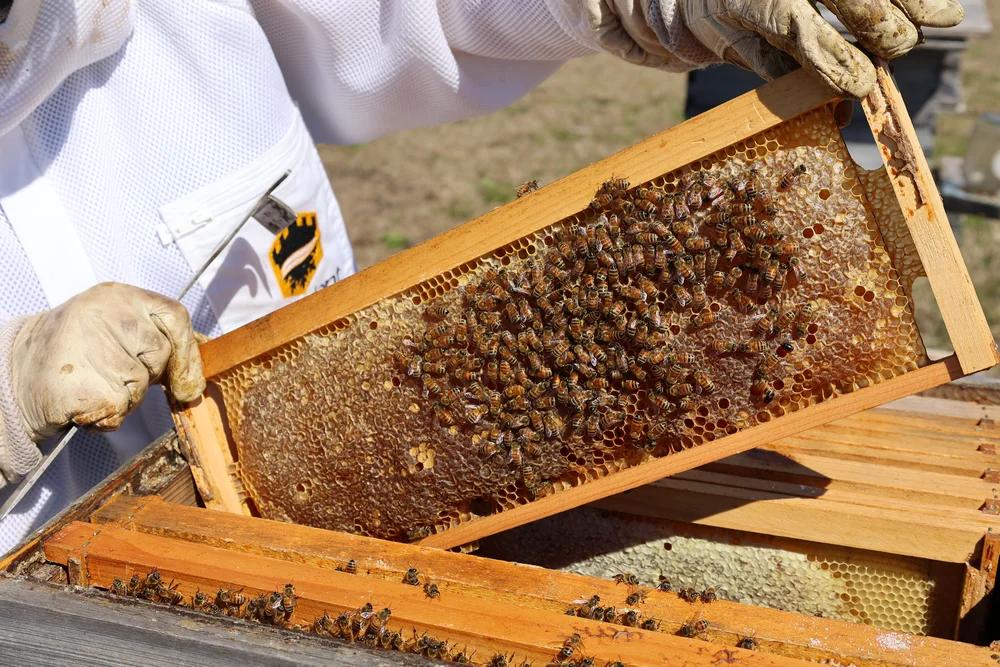
Bees, hive products and pollination crops
- Eligible Honey Bee Species
- Apis mellifera (Italian / Western Honey Bee — migratory & commercial apiaries) and Apis cerana indica (Indian Hive Bee — hill, forest & tribal regions), plus stingless bees (Trigona / Tetragonula spp.) where notified under state/NBB programs.
- Eligible Apiary Infrastructure
- 8-frame and 10-frame ISI-standard Langstroth wooden/plastic hives, supers, queen gates, smokers, honey extractors, and migration gear.
- Eligible Beehive Products
- Raw Honey (Acacia, Multi-Flora, Mustard, Litchi, Eucalyptus, Saffron-infused), Comb Honey, Beeswax, Royal Jelly, Propolis, Bee Pollen, and Bee Venom.
- Target Pollination Crops
- Apple, Almond, Cherry, Pear, Plum, Litchi, Citrus, Mustard, Sunflower, Coriander, Cardamom, and cross-pollinated vegetable seed crops.
Projects in this domain
Open a project to see what it involves, what it may cost, and which schemes to check. Costs and returns are planning estimates. Confirm scheme terms and eligibility with the relevant authority before investing.
Custom Hiring Centre (Commercial Apiary — Model-II)
Project overview
A commercial apiary and service hub maintaining a minimum fleet of 1,000 scientific honeybee colonies along with extraction machinery, migration cages, and protective gear to rent bee colonies to orchardists/farmers for crop pollination and harvest commercial honey & hive products.
- Estimated cost
- ₹55.00 Lakh to ₹75.00 Lakh per unit (NBHM Mini Mission-I official cost norm: up to ₹75.00 Lakh per Custom Hiring Centre; MIDH individual pollination support norm: ₹2,000/colony + ₹2,000/hive up to 50 units + ₹20,000 equipment set = ₹2.20 Lakh).
- Site size or capacity
- Minimum 1,000 colonies per Custom Hiring Centre under NBHM Model-II (Model-I individual/group units start at 50 colonies); requires 500–1,000 sq. m base yard/storage shed plus migratory foraging access.
- Indicative returns
- 32% to 45% annually (dual revenue from 35–45 MT/yr honey & beeswax harvest plus seasonal orchard pollination rental fees of ₹800–₹1,500 per colony/season; payback in 2 to 2.5 years).
- Suitable crops, products or inputs
- Apis mellifera and Apis cerana indica (plus region-specific scheme-approved species; mandatory Madhukranti portal registration).
- Scheme assistance to check
- NBHM–NBB (Mini Mission-I): 50% for individuals/firms, 75% for FPOs/SHGs/Cooperatives (up to ₹56.20 Lakh max ceiling in general states), and 90% in North-Eastern & Himalayan States/UTs (including J&K & Ladakh). MIDH: 40%–50% for individual beekeepers (up to 50 colonies). KVIC-PMEGP / PMFME: 15%–35% subsidy for allied hive-product enterprises.
- Market opportunities
- High-density Apple, Almond, Cherry, Litchi, Mustard, and Sunflower growers seeking 25%–40% pollination yield boosts, alongside bulk raw honey aggregators and exporters.
- Programme references
- NBHM–NBB [Mini Mission-I] / MIDH / PMFME / PMEGP
Honey Processing Unit (5 M Tonne / Day) — Filtration, Packaging, Beeswax & Bee Product Processing
Project overview
An FSSAI-compliant post-harvest processing plant equipped with pre-heating/liquefaction tanks, micro-filtration units, vacuum moisture-reduction evaporators (<18% moisture), automated glass/PET bottle & pouch filling lines, beeswax melting/sheet-foundation press, and pollen/propolis/royal-jelly value-addition units.
- Estimated cost
- ₹150.00 Lakh to ₹240.00 Lakh for a 5 MT/day automated plant (NBHM Mini Mission-II covers Honey Processing Units up to ₹500.00 Lakh project cost, Honey Collection & Marketing Centres @ ₹30.00 Lakh, and Packaging & Cold Storage @ ₹80.00 Lakh).
- Site size or capacity
- 500 sq. m to 1,500 sq. m built-up FSSAI-grade industrial/agro-processing shed (processing capacity of 5 MT/day, or ~1,250–1,500 MT/annum).
- Indicative returns
- 28% to 38% annually (payback period of 2.5 to 3.5 years; raw-to-processed value addition increases net realization by 45%–70%).
- Suitable crops, products or inputs
- Honey and secondary hive products (Beeswax, Royal Jelly, Propolis, Bee Pollen, Bee Venom, Comb Honey) sourced from Apis mellifera, Apis cerana indica, and other scheme-approved bee species.
- Scheme assistance to check
- NBHM–NBB (Mini Mission-II): Credit-linked subsidy of 50% (Individuals/Firms), 75% (FPOs/SHGs/Cooperatives), and 90% (NE & Himalayan States/UTs) up to a maximum ceiling of ₹3.00 Crore per processing unit. PMFME: 35% up to ₹10 Lakh (micro-units) or up to ₹3.00 Crore (FPOs/SHGs) for value-added honey products.
- Market opportunities
- Organized FMCG retail chains, pharmaceutical/Ayurvedic companies, cosmetic/beeswax manufacturers, D2C organic honey brands, and international bulk/retail honey exports (USA, UAE, Saudi Arabia, EU).
- Programme references
- NBHM–NBB [Mini Mission-II] / PMFME / KVIC-PMEGP
Integrated Custom Hiring Centre & Honey Processing Unit (5 M Tonne / Day)
Project overview
A backward-and-forward integrated apiculture enterprise combining a 1,000-colony Custom Hiring Centre (guaranteed captive raw honey supply + pollination services) with an on-site 5 MT/day automated honey filtration, moisture-reduction, bottling, and beeswax/hive-product processing facility.
- Estimated cost
- ₹150.00 Lakh to ₹250.00 Lakh composite project cost (integrating CHC infrastructure + 5 MT/day processing, bottling, and cold storage/packaging line).
- Site size or capacity
- 1,500 sq. m to 3,000 sq. m base processing & storage complex plus migratory apiary routes across orchards and oilseed/forest belts.
- Indicative returns
- 32% to 42% annually (eliminates middleman procurement margins and ensures 100% single-origin Madhukranti traceability; payback in 2.5 to 3 years).
- Suitable crops, products or inputs
- Apis mellifera and Apis cerana indica (plus other scheme-approved species registered on the Madhukranti portal for end-to-end NMR/blockchain traceability).
- Scheme assistance to check
- NBHM–NBB (Composite MM-I + MM-II): 50% (Individuals/Firms), 75% (FPOs/SHGs/Cooperatives), and 90% (NE & Himalayan States/UTs including J&K) subject to component ceilings (₹56.20 Lakh for CHC + up to ₹3.00 Crore for Honey Processing).
- Market opportunities
- Direct export contracts requiring NMR-tested, single-flora traceable honey (e.g., Kashmir Acacia Honey, Litchi Honey, Forest Honey), modern trade supermarkets, and institutional buyers.
- Programme references
- NBHM–NBB [Mini Mission-I & Mini Mission-II Composite]
QNSDC — Quality Nucleus Stock Development Centre
Project overview
A specialized scientific bee-breeding and queen-rearing facility equipped with instrumental insemination tools, grafting laboratories, mating nuclei boxes, disease-screening microscopes, and isolated breeding yards to produce disease-free, high-yielding queen bees and nucleus colonies.
- Estimated cost
- ₹30.00 Lakh to ₹75.00 Lakh per unit (NBHM Mini Mission-I official base norm: ₹30.00 Lakh for Quality Nucleus Stock Centre and ₹12.50 Lakh for registered Bee Breeders; expanded commercial QNSDCs with lab/isolation infrastructure range up to ₹75.00 Lakh).
- Site size or capacity
- 1,000 sq. m to 4,000 sq. m isolated breeding apiary & queen-rearing lab (mandated output of at least 2,000 quality nucleus colonies / queens over 3 years).
- Indicative returns
- 35% to 50% annually (strong recurring demand for pedigree queens @ ₹500–₹1,200/queen and 4-frame nucleus colonies @ ₹2,500–₹3,500/colony, plus honey byproducts).
- Suitable crops, products or inputs
- Selective pedigree breeding of Apis mellifera and Apis cerana indica (plus region-specific stingless/indigenous bee species approved under NBB/NBHM).
- Scheme assistance to check
- NBHM–NBB (Mini Mission-I): 100% assistance (up to ₹30.00 Lakh) for Public Sector / SAUs / ICAR institutions, and 50% credit-linked assistance (up to ₹30.00 Lakh; 90% in NE/Himalayan States/UTs) for NBB-registered expert member firms, societies, and FPOs.
- Market opportunities
- State Horticulture Departments, newly formed Beekeeping FPOs (100+ FPOs promoted under NBHM), commercial CHCs, and individual beekeepers replacing aging queens.
- Programme references
- NBHM–NBB [Mini Mission-I, Item 1 & 2]
Integrated Custom Hiring Centre & QNSDC (Quality Nucleus Stock Development Centre)
Project overview
A dual-purpose apiculture nucleus hub combining a 1,000+ colony commercial Custom Hiring Centre for crop pollination with a scientific Queen-Rearing & Quality Nucleus Stock Development Centre to multiply pedigree colonies and supply local beekeepers.
- Estimated cost
- ₹85.00 Lakh to ₹105.00 Lakh composite project cost (combining ₹55.00–₹75.00 Lakh CHC norm + ₹30.00 Lakh QNSDC norm).
- Site size or capacity
- 1,500 sq. m to 4,000 sq. m breeding & equipment hub plus migratory orchard/field pollination circuits.
- Indicative returns
- 34% to 46% annually (three synchronized revenue streams: colony multiplication/queen sales, pollination hiring fees, and raw honey/beeswax production; payback in 2 to 2.5 years).
- Suitable crops, products or inputs
- Apis mellifera and Apis cerana indica (and other scheme-approved species maintained under strict NBB breed purity and disease-free protocols).
- Scheme assistance to check
- NBHM–NBB (Mini Mission-I): 50% (Individuals/NBB-registered firms), 75% (FPOs/SHGs/Cooperatives), and 90% (NE & Himalayan States/UTs including J&K) across eligible CHC and QNSDC components.
- Market opportunities
- Regional beekeeping clusters, state government colony distribution tenders, horticulture/oilseed FPOs, and commercial migratory beekeepers.
- Programme references
- NBHM–NBB [Mini Mission-I Composite]
Eligibility and scheme notes
- NBHM Pattern of Assistance: Under the National Beekeeping & Honey Mission (implemented through National Bee Board), credit-linked back-ended assistance is 50% for individuals/firms, 75% for FPOs/SHGs/Cooperatives, 90% in North-Eastern & Himalayan States/UTs (including J&K and Ladakh), and 100% for public sector/research institutions.
- Mandatory Registration & Traceability: All participating beekeepers, societies, firms, and processing units must register on the NBB Madhukranti Portal (madhukranti.in) for batch-level source traceability and FSSAI compliance.
- Financial Benchmarks: Expected ROI figures represent indicative commercial project feasibility benchmarks for entrepreneur guidance; official subsidy disbursement is governed by NBB PAC/PA&MC project appraisal and approved unit ceilings.
Ready to apply?
Tell us about your project in the member portal. If you need to sign in, we’ll take you straight to this application afterwards.